
By Sam Halberstadt · Reviewed by Marina Chen
Editor · USCG-licensed Master 50 GT · Updated May 6, 2026
Pick the right anchorage
The bottom is the single most important variable. On a NOAA chart or your chartplotter, look for two-letter codes near the soundings: S (sand) and M (mud) hold almost any anchor reliably; G (gravel), R (rock), and Co (coral) are problem bottoms; Wd (weed/grass) is the worst common bottom because anchors skate across the matted vegetation without ever reaching the substrate underneath. Combinations like 'S M' (sand and mud) are excellent.
Look for a depth between 8 and 25 feet at high tide. Shallower than 8 ft and you risk swinging into a shoal as the wind shifts; deeper than 25 ft and you start running out of rode at 7:1 scope. Cross-check the chart against your sonar — chart soundings are years old and shoaling happens.
Check shelter. A protected anchorage takes the wind off the predicted shift, not just the current wind. If the forecast is southwest tonight veering northwest by morning, the cove that's protected from the southwest is exposed to the northwest at 3 a.m. Read the weather, then pick.
Check the tide range and the math. If today's range is 6 ft and you anchor in 10 ft at low water, you'll be in 16 ft at high tide and your scope is now wrong. Always calculate scope for the maximum depth you'll see during your stay.
Calculate your scope (the math that matters)
Scope is the ratio of rode you've paid out to the total height from your bow roller to the seabed. The formula: scope = (rode out) ÷ (max water depth at high tide + bow freeboard). The freeboard piece — measured from the water to your bow roller — is the part most people forget; on a 32-foot cruiser it's typically 4–5 ft and adds meaningfully to the equation.
Use 7:1 for an overnight stay in normal conditions. Use 5:1 for a daytime lunch hook in calm water with light wind. Use 10:1 in heavy weather, when a forecast front is coming through, or anytime you have the room. With all-chain rode, the catenary curve effectively adds one ratio number — 5:1 with chain holds about as well as 6:1 with mostly nylon.
Worked example: 12 ft of high-tide depth + 4 ft of bow freeboard = 16 ft total height. At 7:1 scope, that's 112 ft of rode. Mark your rode in 25 ft increments with whipping twine, paint, or commercial markers — 'enough rode' is not a number you guess.
Set the hook properly
Approach the spot at idle, into the wind. The bow needs to be exactly into the wind when the anchor leaves the roller — any side angle pulls the rode across the chain locker and snags it. Bring the boat to a complete stop directly over your target spot.
Lower the anchor — never drop it. A dropped anchor lands on its side with chain piled on top of it, and the anchor can't dig in until you've drifted far enough to pull the chain off. Lower at a controlled rate until the anchor touches bottom, then pay out rode steadily as the boat drifts back. The goal is a straight line of rode along the bottom from the anchor to the boat.
Once all your scope is paid out, take a wrap on a bow cleat and snub the line. Let the boat settle backward until the rode comes tight, then put the engine in reverse and bring up to roughly 1500 RPM for 15–30 seconds. The bow should dip slightly as the anchor digs in. Watch two fixed objects ashore — a tree, a rock, a chimney — that are close to in line with each other; if the alignment doesn't change while you're backing down, the anchor is set.
Confirm the set and rig for the night
Take a transit bearing on two pairs of fixed objects — one off the beam, one off the bow. Note them in your log. If both transits stay aligned over the next 30 minutes, you're not dragging. If either changes, you are.
Set an anchor alarm on your chartplotter or phone (Anchor Pro, Drag Queen, Garmin built-in) with a swing radius about 20% larger than your scope. The alarm wakes you up if you drift outside the circle.
In a busy anchorage, watch how other boats are lying. If you swing differently from everyone else, you're either on different rode (chain vs nylon) or your anchor is set differently than theirs. Both are worth understanding before bedtime.
Rig a snubber if you're on all-chain rode. A 15-ft length of three-strand nylon with a chain hook on one end takes the shock load off the windlass and gypsy and makes the boat ride quieter at anchor.
Step by step
- 1
Survey the anchorage
Read the chart for bottom composition (look for S or M), depth, and hazards. Check the tide range and wind forecast for the next 12 hours, including any predicted shifts.
- 2
Approach into the wind
Bring the boat to a complete stop at idle directly over your target spot, bow pointed into the wind. Any side angle will tangle the rode in the chain locker.
- 3
Lower the anchor
Lower (don't drop) the anchor until it touches bottom. Pay out rode steadily as the boat drifts back, keeping the line straight along the seabed.
- 4
Pay out scope
Use 7:1 ratio of rode to (high-tide depth + bow freeboard). Mark your rode in 25 ft increments — 'enough' is not a guess.
- 5
Snub and set
Cleat the rode, then back down in reverse at 1500 RPM for 15–30 seconds. Watch two fixed points ashore in line — if the bearing doesn't change, you're set.
- 6
Set the anchor alarm
Use chartplotter alarm at swing radius 20% larger than scope, plus visual transit bearings on shore. Re-check transits every 30 minutes for the first hour.
Frequently asked
Take a transit on two fixed points ashore — a tree behind a chimney, a rock between two pilings. If the bearings don't change while you back down at 1500 RPM for 15–30 seconds, the anchor is set. If anything moves, the anchor is dragging across the bottom and you need to re-set.
Keep reading
 Anchoring
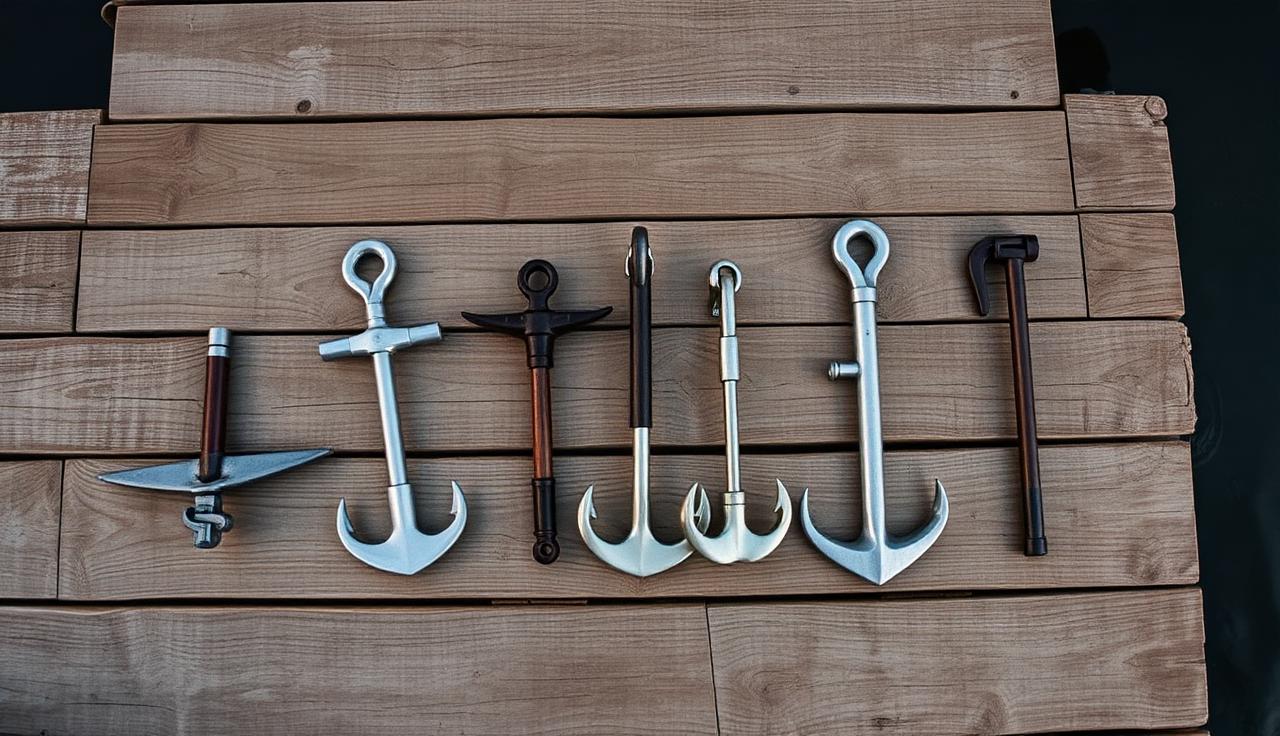
Best Boat Anchors in 2026 (Tested in Mud, Sand, and Grass)
Tested across mud, sand, and grass over two seasons. The picks that held — and the brand-name failures.
 Anchoring
Anchor Scope Ratio Explained: 5:1, 7:1, and the Catenary Math That Matters
Scope ratios broken down with the chain catenary effect most calculators ignore.